
01
Template sameness
A generic theme can hide what makes the business credible. We shape the architecture, proof, and interface around the real service and buying decision.
Custom websites, WordPress, redesigns, migrations, technical SEO, and ongoing management — selected around the way your Spring business sells, publishes, and operates.
A generic theme can hide what makes the business credible. We shape the architecture, proof, and interface around the real service and buying decision.
Disconnected pages make it difficult to understand what the business does and where it works. We plan the hierarchy and internal links before production.
Visitors need the right proof and next action at the right moment. Calls, forms, text actions, scheduling, or other integrations are chosen from the actual workflow.
Navigation, calls, text actions, forms, and proof remain easy to reach and use on a phone.
Forms can collect the information the business actually needs while remaining accessible, secure, and appropriate for the service.
Submissions, analytics, consent, and integrations are tested so the team can distinguish a website issue from an operations issue.
A page builder, hosted template, custom stack, or WordPress site can each be right or wrong depending on editing, integrations, security, and maintenance. We assess the requirements before recommending a replacement.
New services, locations, staff, projects, resources, or campaigns become expensive when every page is a one-off. Structured content and reusable components remove that constraint.
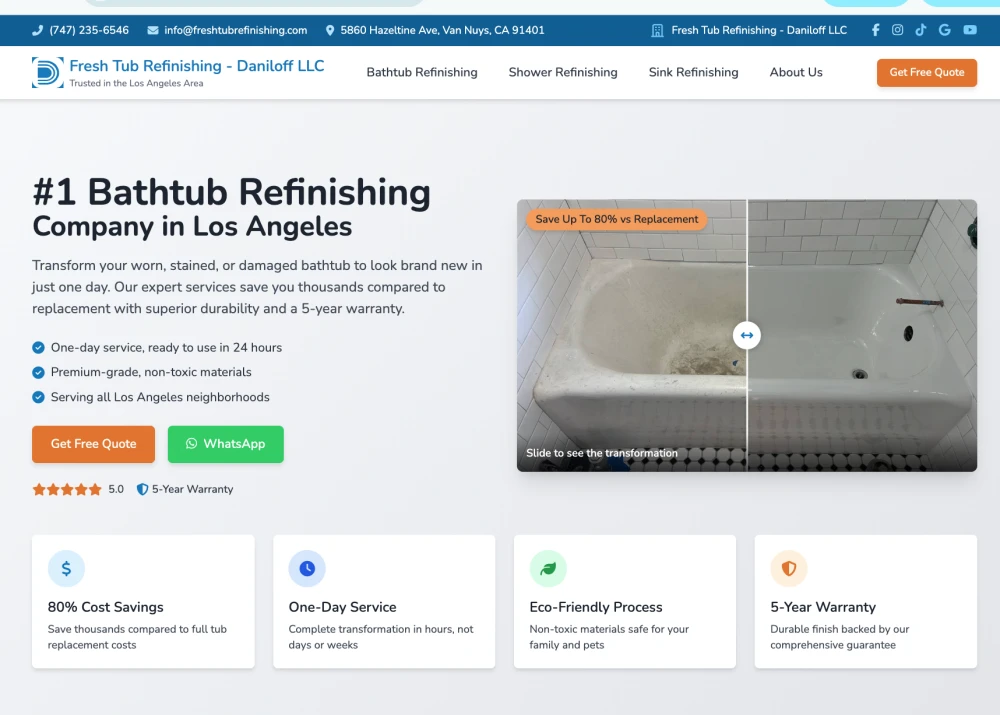
The archived Fresh Tub Refinishing implementation shows the kind of practical structure used for a local service business: clear service explanations, visible project evidence, and direct inquiry paths. It is presented as website implementation evidence, not as a current ranking, traffic, or lead-volume claim.
Property, neighborhood, agent, media, search, and lead-routing requirements receive a deliberate content and integration model.
Service discovery, provider information, locations, scheduling, accessibility, and approved patient resources are organized around the practice workflow.
Practice areas, attorney credentials, verified proof, intake paths, and jurisdiction-specific advertising requirements inform the build.
Services, service areas, project evidence, financing information, reviews supplied by the business, and estimate paths are connected.
Clear service qualification, professional credentials, secure vendor integrations, and careful handling of claims shape the architecture.
Locations, menus, events, accessibility, reservations, ordering providers, and search information stay accurate and easy to operate.
No. WordPress is often the right choice for active publishing, multiple editors, structured content, and mature CMS requirements. A lightweight custom architecture fits when broad CMS access would add unnecessary complexity.
Yes. Redesign work can include content and URL inventory, migration planning, redirects, analytics, forms, structured data, performance, and post-launch validation.
Technical SEO and search-informed architecture are core capabilities. Content or local search work is scoped from the business, available evidence, and competitive context; rankings are not guaranteed.
Yes, when that is an operational requirement. The editing model may use WordPress, structured content, or a controlled publishing workflow depending on who publishes and how often.
Projects are scoped from requirements such as content, platform, migration, integrations, design, search risk, and ongoing support. There is no universal package price.
The schedule depends on discovery, content readiness, number of templates, integrations, approvals, and migration risk. A realistic delivery plan follows the initial assessment.
Share the current URL, the operating constraints, and what needs to change. We can determine the right architecture and a responsible path to launch.